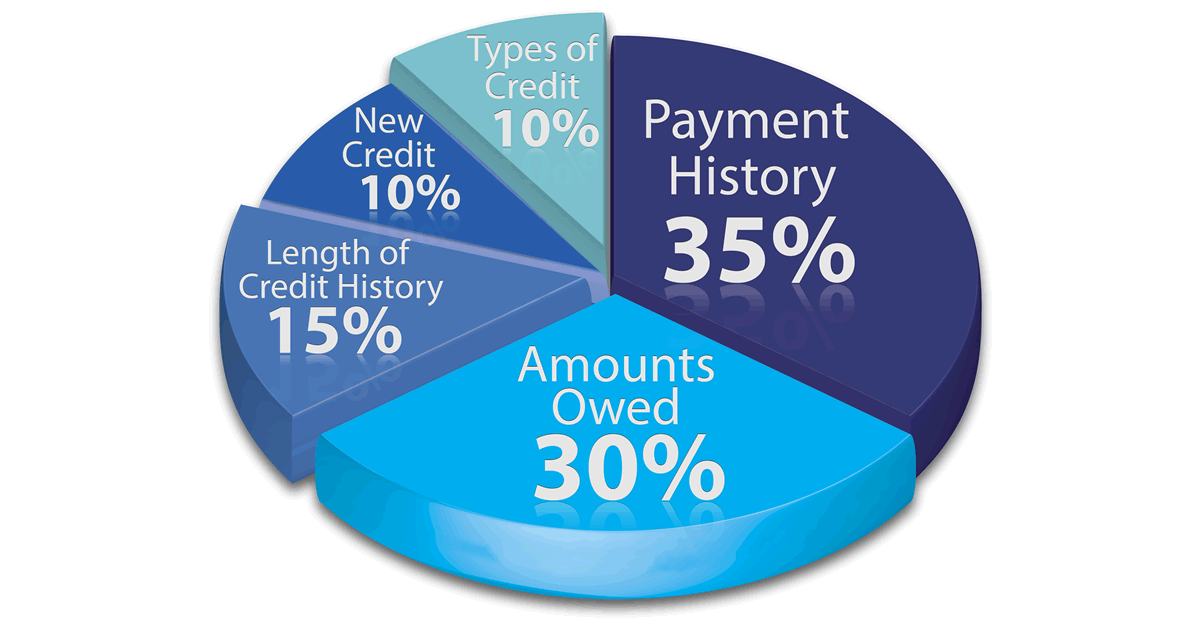
A credit score is a prediction of your credit behavior, such as how likely you are to pay a loan back on time based on information from your credit reports. Companies use credit scores to make decisions on whether to offer you a mortgage, credit card, auto loan, and other credit products, as well as for tenant screening for an apartment and insurance. They are also used to determine the interest rate and credit limit you receive. Here’s the breakdown on how your score is determined:
Payment History – 35% of Your Score
*A single 30 or 60 day missed payment is easy to recover from but can hurt your score significantly.
*A 90-day missed payment is more damaging and could disqualify you from certain loans.
*After 90 days, missed payments can become charge-offs and be sent to a collection agent. This is never a good idea to let this happen.
Amount Owed – 30% of Your Score
*Having credit accounts and owing money on them does not necessarily mean you are a high-risk borrower. However, if you are using a lot of your available credit, this may indicate that you are overextended and banks can interpret this to mean that you are at a higher risk of defaulting.
*Lenders look at how much of your available credit (your credit limit) is being used. Lenders like to see that you are responsibly able to use credit and pay if off regularly.
*If you have a mix of account that are “maxed out” or at their limit, that may impact your credit score.
Credit Age – 15% of Your Score
*If you are trying to pare down your accounts, don’t close your oldest credit card – it’s what give you a long credit history. Credit bureaus look at the age of your oldest account, newest account and the average age of all accounts.
*Sometimes, credit card companies will close an old account that never gets used. Use an old card every now and then to prevent a potential score drop.
*When an older account (like a mortgage or student loan) falls off your report, your score could drop since you are losing the credit history that comes with that account. Older histories show stability.
Types of Credit Accounts Accounts – 10% of Your Score
*Having different account types (such as credit cards and loans) can actually help your credit.
*Don’t fret about an exact number or mixture, since you will build these over time. The important thing is that your are using accounts responsibly.
*If a mortgage, student loan or auto loan falls off your credit report, your score could drop since your are losing a line of credit that’s give you a lot of credit history.
New Credit/Hard Inquiries – 10% of Your Score
*Good news! One hard inquiry is a temporary ding and scores usually bounce back in 3 month’s time. Considers how many new accounts you recently opened and the number of hard inquiries were made when you applied for any new loans.
*But several hard inquiries in a short amount of time will lower your credit score as much as 50 points! The best example of this is car dealers pulling your credit several times trying to find you their best deal with financial institutions they regularly deal with. Those are HARD inquiries.
*Plan ahead. Minimize your hard inquiries at least 9 to 12 months before trying to get a mortgage or larger size loan.
AND REMEMBER…when the Evergreen Park Schools Federal Credit Union pulls your credit, it is a SOFT INQUIRY and WILL NOT AFFECT your credit score. Come talk to us first!